
Free tool · no sign-up
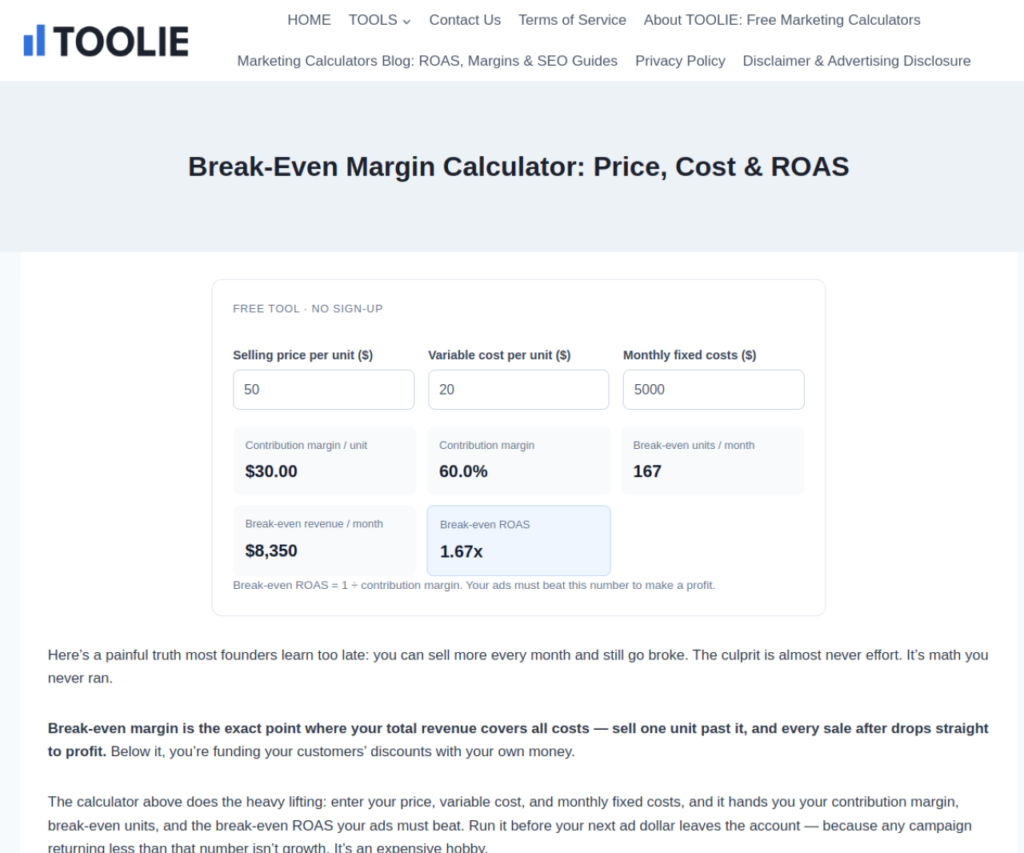
Break-even ROAS = 1 ÷ contribution margin. Your ads must beat this number to make a profit.
Here’s a painful truth most founders learn too late: you can sell more every month and still go broke. The culprit is almost never effort. It’s math you never ran.
Break-even margin is the exact point where your total revenue covers all costs — sell one unit past it, and every sale after drops straight to profit. Below it, you’re funding your customers’ discounts with your own money.
The calculator above does the heavy lifting: enter your price, variable cost, and monthly fixed costs, and it hands you your contribution margin, break-even units, and the break-even ROAS your ads must beat. Run it before your next ad dollar leaves the account — because any campaign returning less than that number isn’t growth. It’s an expensive hobby.
How to use the break-even margin calculator
What Is Break-Even Margin?
The break-even margin is the percentage or dollar amount of sales revenue required to cover all fixed and variable costs associated with producing and selling your product or service. Once this threshold is crossed, every additional unit sold contributes directly to profit.
Fixed Costs vs. Variable Costs Explained
To accurately calculate your margins, you must categorize your expenses correctly:
- Fixed Costs: Expenses that do not change regardless of how many units you sell (e.g., software subscriptions, website hosting, office rent, baseline salaries).
- Variable Costs: Expenses that scale directly with your sales volume (e.g., raw materials, packaging, shipping fees, transaction processing fees, and cost of goods sold).
The Break-Even Formula
Break-Even Units Formula:
Break-Even Point (Units) = Fixed Costs / (Price Per Unit - Variable Cost Per Unit)
Contribution Margin Ratio:
Contribution Margin (%) = (Revenue - Variable Costs) / Revenue
Step-by-Step Practical Calculation Example
Imagine you launch a direct-to-consumer physical product with the following financial breakdown:
- Monthly Fixed Costs: $5,000 (ads, hosting, operations).
- Selling Price Per Unit: $50.
- Variable Cost Per Unit: $20 (manufacturing & shipping).
- Contribution Margin Per Unit: $50 – $20 = $30.
- Break-Even Units: $5,000 / $30 = 167 units per month.
Why Tracking Break-Even Margins Protects Your Business
Operating without a clear break-even calculation leaves you vulnerable to cash flow crunches. By understanding your margins, you can:
- Set optimal retail prices that protect your profit margins.
- Determine maximum allowable Customer Acquisition Cost (CAC) for paid ads.
- Identify bloated fixed overhead expenses before they drain your cash reserves.
Once you know your margin, plan your ad budget with the ROAS calculator — and read what makes a good ROAS before you set targets.
Frequently Asked Questions (FAQ)
What is a healthy contribution margin?
A healthy contribution margin typically ranges from 40% to 70%+ depending on the industry. E-commerce physical goods usually aim for at least 50% to absorb rising fulfillment and ad costs.
How do shipping fees affect the break-even point?
Shipping is a variable cost. If you offer “free shipping,” you must factor the shipping cost into your variable cost per unit, which increases the number of units you need to sell to break even.
Can a business be profitable while having negative cash flow?
Yes. Many businesses show paper profits on their income statements, but due to inventory holding costs and delayed accounts receivable, they experience temporary cash shortages.
Selling on Amazon? The break-even ACoS calculator folds real 2026 Amazon referral and FBA fees into the same math.
Related tools for sellers: the Etsy Offsite Ads Break-Even ROAS Calculator for Etsy sellers, the Contribution Margin Calculator for a per-unit deep dive, and the Shopify / Stripe / PayPal Fee Calculator for platform fees.