
Free tool · no sign-up
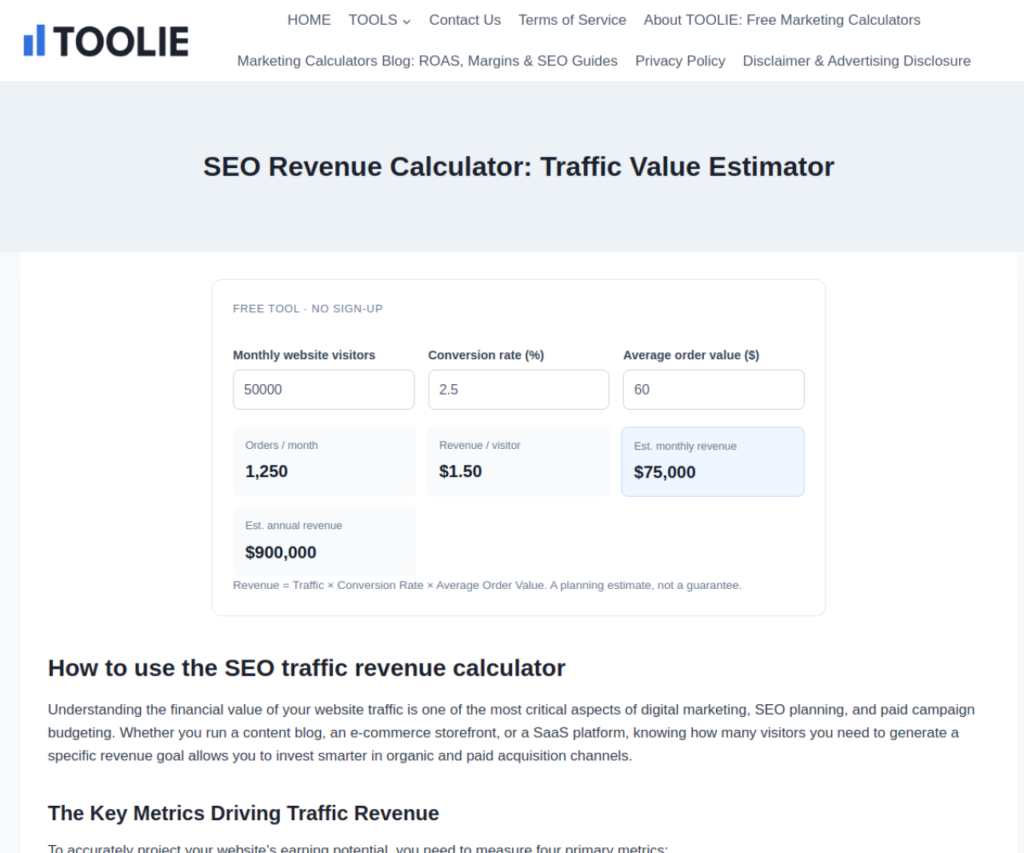
Revenue = Traffic × Conversion Rate × Average Order Value. A planning estimate, not a guarantee.
How to use the SEO traffic revenue calculator
Understanding the financial value of your website traffic is one of the most critical aspects of digital marketing, SEO planning, and paid campaign budgeting. Whether you run a content blog, an e-commerce storefront, or a SaaS platform, knowing how many visitors you need to generate a specific revenue goal allows you to invest smarter in organic and paid acquisition channels.
The Key Metrics Driving Traffic Revenue
To accurately project your website’s earning potential, you need to measure four primary metrics:
- Monthly Organic/Paid Traffic (Impressions/Sessions): The total number of unique visits or pageviews your website receives in a given month.
- Click-Through Rate (CTR): The percentage of SERP impressions that turn into actual website visits, or internal CTA clicks.
- Conversion Rate (CR): The percentage of total website visitors who complete a desired paid action (e.g., buying a product, subscribing to a paid tier, or clicking an ad).
- Average Order Value (AOV) or RPM: For e-commerce/SaaS, this is the average revenue generated per paying customer. For content sites, RPM (Revenue Per Mille) measures earnings per 1,000 pageviews.
The Traffic Revenue Formula Explained
The mathematical model used by this calculator depends on your monetization strategy:
For E-Commerce & Lead Generation:
Estimated Revenue = Total Traffic × Conversion Rate (%) × Average Order Value ($)
For Content & Ad-Based Websites (RPM Model):
Estimated Revenue = (Total Monthly Pageviews / 1,000) × Page RPM ($)
For the full method, see how to estimate SEO traffic revenue, including what a #1 Google ranking is worth at each position.
Step-by-Step Practical Example
Let’s say you operate an e-commerce platform and want to project revenue based on improved search rankings:
- Target Organic Visitors: 50,000 visitors per month.
- Estimated Conversion Rate: 2.5% (meaning 1,250 buyers).
- Average Order Value (AOV): $60 per order.
- Calculation: 50,000 × 0.025 × $60 = $75,000 Monthly Revenue.
Strategies to Improve Your Traffic Revenue Potential
If your projected numbers are lower than your business goals, consider optimizing these three levers:
1. Maximize High-Intent Traffic: Focus your SEO efforts on commercial and transactional keywords rather than purely informational queries. High-intent traffic converts at significantly higher rates.
2. Optimize Conversion Rates (CRO): A modest increase in conversion rate from 2% to 3% represents a 50% increase in total revenue without needing any additional traffic.
3. Increase Customer Lifetime Value (LTV): Utilize email marketing upsells, bundle pricing, and subscription models to raise the revenue earned per customer acquired.
Frequently Asked Questions (FAQ)
What is a good average conversion rate for website traffic?
Across most industries, a standard website conversion rate ranges between 2% and 4%. E-commerce usually averages around 2.5%, while specialized B2B software and high-intent lead gen pages can achieve 5% to 10%+.
How does Google ranking position affect traffic volume?
The #1 organic spot on Google captures roughly 28% to 32% of total search clicks. Position #2 drops to ~15%, and position #3 drops to ~10%. Moving from page 2 into the top 3 results in exponential traffic growth.
What is RPM in ad-based revenue?
RPM stands for “Revenue Per Mille” (Mille means thousand in Latin). It indicates how much money you earn for every 1,000 pageviews served on your site through ad networks like Google AdSense, Ezoic, or Raptive.